

News & Insights
Latest news and legal insights from HANBYOL LAW LLC.
"Jail for raising suspicions? No such country"
| |||||||||


On Feb. 22, the Supreme Court handed down its ruling confirming the conviction of former lawmaker Chung Bong-joo. At the time, the question of when Chung would go to jail was a big topic on Twitter, with some supporters saying, "I wonder if the government is trying to imprison Chung as soon as possible to reduce the influence of the Komsuda." But Kim Yong-won, a lawyer with more than eight years of experience as an investigative prosecutor, said in a phone conversation with a reporter on the same day, "I wonder if the government is trying to imprison Chung as soon as possible.
"The case of Chung is not about time in prison. It's more about the fact that there are very few countries that use slaps on the wrist for cases like this. We need to think about how far we allow freedom of political expression."
"I expected the Supreme Court to correct the unreasonable expansion of defamation, etc., but seeing the conviction of Jeong, I felt that Korea is still a long way from becoming a democratic country," said Kim.
In a book he published in March, he quipped that "the laws of insult, libel, publishing falsehoods, and slandering candidates in this country are like the sturdy teeth of the dogs in George Orwell's Animal Farm, loyal to the pigs."
"If there's even a 10 percent chance of falsity, don't question it."
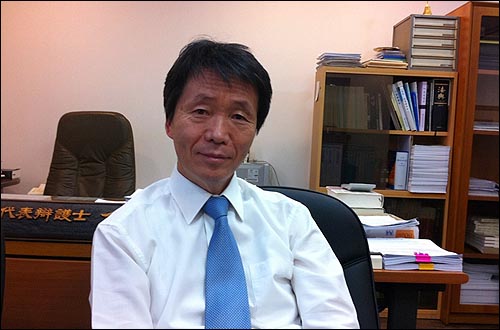
Kim has nothing against Chung. Rather, he is a close college classmate (Seoul National University Law School) of Supreme Court Justice Lee Sang-hoon, the presiding judge in Jung's conviction. In other words, he has no special relationship to defend Jung. Nevertheless, in an interview with <Oh My News> on March 23, he criticized the Supreme Court's ruling, saying, "The Supreme Court's ruling is a comprehensive judgment that shows the current state of 'freedom of expression' in Korea."
Reviewing the Supreme Court's ruling, Kim said, "The Supreme Court interpreted what is merely an opinion or evaluation as an 'expression of fact' in an expanded way." "It would be a violation of freedom of expression to determine that it is the dissemination of false facts when it is merely an expression of opinion," he said.
"If you think even a little bit that (the allegation) might be false, you see it as willfulness," he said, adding, "If there's a 90 percent chance that the allegation is true and a 10 percent chance that it's false, you should be able to say that, but if you think there's even a 10 percent chance that it's false, you can punish it."
 | ||||||


"At the end of the day, what this Supreme Court ruling is saying is that unless it's blindingly obvious, unless it's 100 percent true, don't raise suspicions," he said, "but if you do, they're scaring you, saying, 'You're going to die, you're going to lose your civil rights.
"Is there any country in the world that sentences a public official or candidate for public office to jail even if the allegations are not true? This is the behavior of a dysfunctional country. There are very few countries that sentence a public official or candidate for public office to prison for saying something that is unfounded. Show me evidence of a country (in a democracy) that has done this in the last 100 years."
"If judges perceive freedom of expression in this way, it is bound to chill the ability to raise legitimate doubts about public officials or candidates for public office," he said, adding, "(This) will inevitably result in unqualified people staying in office or entering public office, to the detriment of the public."
"Those who have risen to power or amassed wealth through unscrupulous means have taught the people that 'you may not slander'. This has made it difficult to raise questions about morality, eligibility for public office, etc."
"The criminalization of spreading falsehoods or defamation is a shackle on the people," he said, adding that "in the United States, prosecutors don't prosecute because it's hard to prove that you knew the falsehoods were false," and "that's why you don't see people prosecuted for defamation of public figures and jailed."
"The people are happy when they can tell what they have seen and felt. There can be no happiness in a place where people have to be careful what they say."
"Criminalizing the publication of falsehoods is not a solution," he said, emphasizing that "it's a matter of announcing that there's a problem, not criminalizing the company that published the falsehoods."
"Sentenced three years after second trial? A crime beyond dereliction of duty"
In particular, Kim argued that the Supreme Court justices who upheld Jung's conviction broke current law. In other words, they violated the Public Offices Election Act, which states that a third judgment must be rendered within three months from the date of the second judgment.
Article 277 of the Public Election Law stipulates that "the second and third trials must be held within three months from the date of the sentence of the previous trial. This is a "mandatory rule regarding the trial period of election offenders. However, the Supreme Court did not confirm Chung's conviction until December 2008, more than three years after the second trial.
"A mandatory rule is a rule that must be followed, unlike a discretionary or advisory rule," Kim said, adding, "Nevertheless, the fact that the third judgment on Jeong's case was issued three years after the second judgment means that the Supreme Court justices violated the law in the course of performing their duties."
"There is no reason for the final judgment of Chung to take three years," he said, adding, "This is not only a disciplinary matter, but a serious violation of the human rights of the people and a criminal offense beyond dereliction of duty."
 | ||||||
He pointed the knife of criticism at the Supreme Court justices, asking, "Why are the justices allowed to break the law when the judges tell them to follow the law?"
"If the fine is more than 1 million won ($1,000,000), the person is disqualified from voting for five years. However, if the Supreme Court's decision is delayed for three years, it will effectively disqualify them for eight years. In the case of Chung, the former lawmaker, he would be disqualified for 13 years. What authority does the Supreme Court have to violate the rights of the accused like this?"
"There's no reason for a Supreme Court decision to take three years," he said, adding, "A decision of this caliber should be written in a day."
"A judgment of this magnitude could be written in a day"
"This is a cavalier disregard for the laws made by the National Assembly and shows the power of judges over the people," he said, adding, "Journalists must fight for freedom of expression and jurists must come forward and criticize."
Mr. Kim has worked as an investigative prosecutor in Seoul, Ulsan, Busan, and Suwon prosecutors' offices from 1983 to 1992. He was known as the "Mercedes Benz prosecutor without brakes" as he investigated the Busan Brothers Uniform Support corruption case, the Busan Subway Headquarters corruption case, and the Ulsan Industrial Complex pollution case.
His 1993 book, <i>Benz Without Brakes> (1993), published shortly after he finished eight and a half years as a prosecutor, sold 200,000 copies, and in March, he published <i>Is There a Judge in Heaven?> published in March. In particular, he has consistently argued that the current laws of libel, insult, spreading falsehoods, and slandering candidates are serious violations of freedom of expression.
| ⓒ 2011 OhmyNews |